


Crypto payment card spending has jumped 2.5 times from a year earlier to reach $759 million in July, supported by nearly 9 million purchases settled mainly through dollar-backed stablecoins.
Summary
- July spending rose from $306 million a year earlier to $759 million.
- Cardholders completed nearly 9 million purchases with an average value of about $86.
- USDC and USDT accounted for a combined 84% of tracked spending.
- Optimism led blockchain settlement with 29%, followed by Solana and Base at 19% each.
A16z crypto reported the figures using data from Paymentscan, which tracks payment activity linked to crypto card programs across several blockchains.
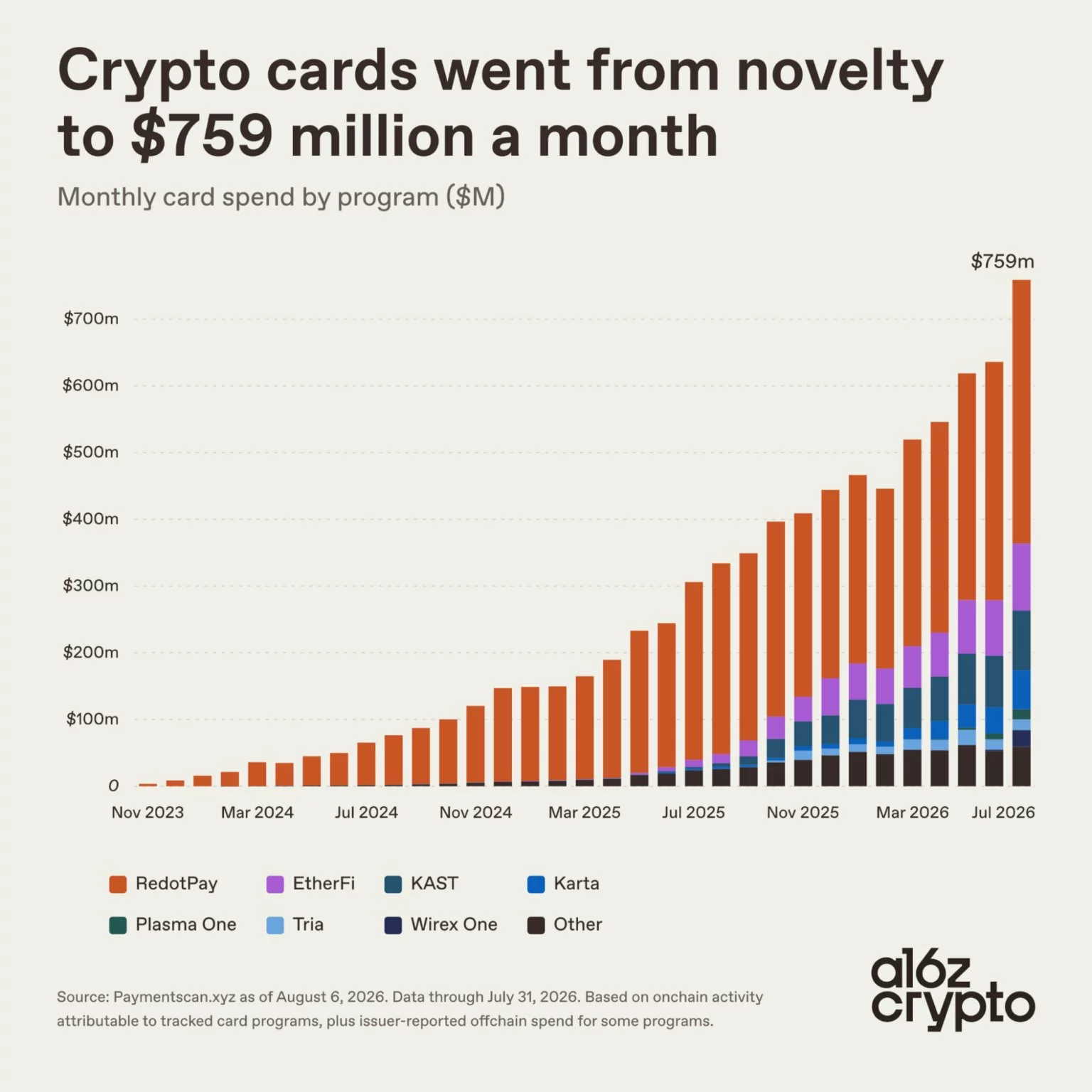
The monthly total has climbed from less than $1 million in October 2023, when Paymentscan began tracking the market, to more than three-quarters of a billion dollars. Card purchase counts have risen alongside spending, reaching nearly 9 million in July from about 5.2 million during the same month last year.
According to the report, the two measures produced an average purchase value of roughly $86. Paymentscan’s data covers on-chain activity that it can connect to individual card programs, although the dataset handles its largest program differently.
RedotPay, which generated the most volume among tracked issuers, self-reported its spending rather than having the transactions directly observed on-chain. A16z identified the distinction in its methodology, making RedotPay’s numbers dependent on information supplied by the company.
Crypto card spending has moved toward dollar stablecoins
USDC handled about 58% of crypto card spending in July, while USDT accounted for another 26%, according to Paymentscan. One year earlier, their respective shares stood at approximately 48% and 7%, meaning USDT recorded the larger increase over the period.
Together, the two dollar-backed tokens processed 84% of the card volume tracked in July. The figures correspond with separate Visa data showing USDC has taken a large share of payment-related stablecoin activity.
In June, USDC processed about $1.21 trillion of the $1.79 trillion in adjusted stablecoin transfers recorded by Visa’s on-chain analytics dashboard, while USDT handled approximately $576 billion. As crypto.news previously reported, adjusted transfer volume rose 63% from May and 125% from June 2025, even as the stablecoin market’s total value declined by $7.7 billion.
Euro-backed tokens have lost their early lead in the card segment. A16z said EURe settled close to 88% of card spending in early 2024, much of it through Gnosis, but its share had fallen to around 2% by July.
The change in token use occurred as card issuers added support for more blockchains and dollar-backed assets. Paymentscan’s figures showed that USDC’s share gained about 10 percentage points over the past year, while USDT’s share increased by about 19 points.
Optimism leads crypto card settlement by chain
Optimism processed approximately 29% of tracked crypto card spending in July, placing it ahead of Solana and Base, which each carried about 19%, Paymentscan data showed. Gnosis accounted for about 2% after serving as the main settlement chain during the market’s early stage.
Gnosis Pay helped produce that initial concentration by introducing what a16z described as the first Visa card connected directly to a self-custodial wallet. As more issuers entered the market, settlement activity spread across networks offering different payment and wallet infrastructure.
Solana’s share also comes as payment providers release cards that use the network for stablecoin transactions. In May, Solayer introduced a Visa card that lets customers spend USDC from the Solana-based Solayer InfiniSVM network. The Solayer card launch followed the opening of Visa and Bridge’s stablecoin card program in 18 countries.
Base, an Ethereum layer-2 network developed by Coinbase, matched Solana’s 19% share in the Paymentscan dataset. Optimism and Base together processed nearly half of the measured volume, while Gnosis’ share fell as EURe use declined.
Crypto cards connect stablecoin balances with Visa merchants
Crypto payment cards allow customers to hold stablecoins with a card provider or keep them in a supported self-custodial wallet, depending on the product. At checkout, the service converts the digital assets into the merchant’s local fiat currency and sends the payment through an established card network.
A16z said merchants generally receive the transaction in the same form as a standard card payment, removing the need for them to directly accept or manage crypto. Customers can use the product wherever the supporting card network operates, while the issuer handles the conversion and settlement process.
Some programs also provide access to dollar-denominated balances without requiring users to maintain a conventional bank account. Custodial services hold the stablecoins for the cardholder, whereas self-custodial products allow customers to retain control through an on-chain wallet until funds are used.
Morph introduced another self-custodial model in August, although its product focuses on direct business payments instead of card spending. The non-custodial payment platform lets businesses and freelancers receive USDC and USDT directly into their wallets through invoices and payment links.
Paymentscan’s tracked card programs used Visa almost exclusively, according to a16z. Despite the increase to $759 million, the report noted that crypto cards remain small compared with established card networks, which process trillions of dollars each month.
U.S. rules are shaping dollar-backed payment tokens
For U.S. users, crypto cards combine a conventional card transaction with a stablecoin issued and managed under a developing federal framework. The GENIUS Act, signed into law in July 2025, established federal standards for payment stablecoin issuers, including requirements tied to reserves, redemption, and supervision.
In February, the Office of the Comptroller of the Currency proposed rules to implement parts of the law. The OCC stablecoin proposal covered reserve composition, liquidity, redemption procedures, capital treatment, and federal oversight of approved issuers.
Visa has continued to build services around several stablecoins rather than committing its payment network to one token. During the company’s July 28 earnings call, CEO Ryan McInerney described its strategy as “multi-coin, multi-chain” and said Visa’s role was “not to pick winners.”
The card company also supports Open USD, a planned stablecoin backed by a consortium of more than 140 companies, while maintaining connections with existing tokens and settlement products. Visa introduced a platform in July that gives banks, fintech companies, and crypto firms access to stablecoin minting, burning, storage, and transfer tools.
Earlier in 2026, Visa and Stripe-owned Bridge announced plans to offer stablecoin-backed cards in more than 100 countries by the end of the year. Their program allows customers to spend stablecoin balances at more than 175 million Visa merchant locations, with Lead Bank supporting on-chain settlement for the cards.
